
Much of the ground surface in Tilkechaur, a hillock spanning approximately 150 ropanis, has developed cracks. While the government promised aid to those who migrated due to the danger, no one has received financial assistance, nor have any steps been taken to relocate families at risk to a safer place.
Balkrishna Thapa, a resident of Tilkechaur in Katari Municipality-10, Udayapur district, was forced to leave his beloved village. He moved from Tilkechaur to Baramjhiya in Katari Municipality-5 on April 29, 2024, after the ground cracked and his house was on the verge of collapsing.
Balkrishna is one of many who faced this situation. His neighbors, Min Bahadur Thapa, Bal Krishna Thapa, Geeta Giri, Dak Bahadur Thapa, Yagya Bahadur Thapa and Keshav Basnet, also relocated. Min Bahadur and Dak Bahadur moved to Sorung Chhabise in Katari Municipality-10 on August 30, 2024.
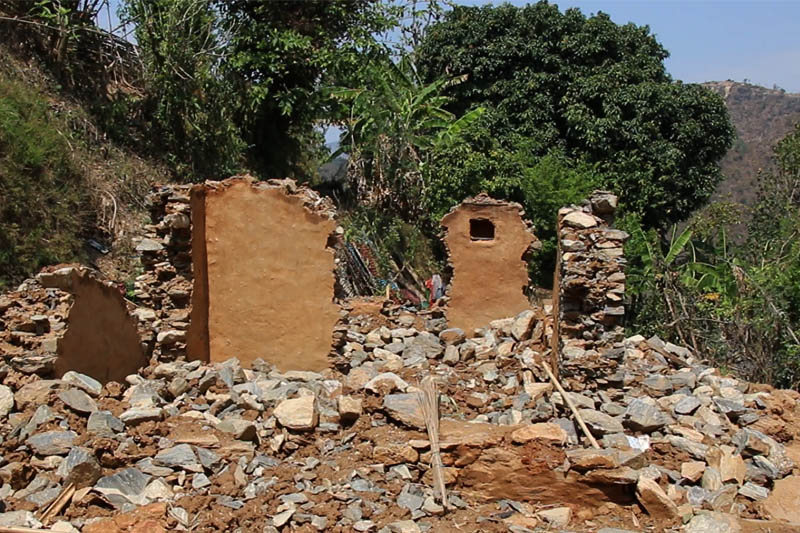
Most of the ground in Tilkechaur, a hillock of about 150 ropanis, has developed cracks. This has caused six of the 17 families to leave their homes, while the other six are still living in their damaged houses at great risk.
Despite government promises to assist those who moved, no one has received financial aid, nor have there been any efforts to relocate vulnerable families to a safer place. The municipality was reportedly supposed to provide funds through the Disaster Management Fund, with contributions from local, provincial and federal governments, based on a report from the Department of Mines and Geology.
Cracks first appeared in the land in Tilkechaur five years ago, in September 2020. According to local resident Ashok Bista, he did not pay much attention when his field near the Sorung River was submerged after the 2015 earthquakes. However, in 2020, the cracks and land subsidence continued, causing houses to crack. A year later, the cracks and subsidence in 17 houses worsened, alarming residents. They reported the issue to the ward office on May 11, 2021.
On May 24, 2021, the then ward chair, Leela Raj Bhattarai, along with local police, intellectuals and political party representatives, inspected Tilkechaur. They concluded that the alarming cracks required them to inform the Katari Municipality, local government and geologists.
The municipality and local administration created a document recommending the immediate relocation of six households to safer areas. However, no progress was made on this recommendation as the 2022 local elections approached.
During the May 13, 2022, local elections, every candidate made the relocation of Tilkechaur residents a key campaign promise. Rajesh Chandra Shrestha was elected mayor of Katari Municipality, and Kshetra Bahadur Khadka became the ward 10 chair.
Residents of Tilkechaur say the elected officials have failed to provide relief and rehabilitation. As the land continues to crack, other families also face the risk of displacement.
Heart in village
Families living in fear in their crumbling homes in Tilkechaur wish they could leave as soon as possible, while those who have already moved are filled with love and memories of the village they left behind.
Balkrishna Thapa, who moved to Baramjhiya in Katari Municipality-5, says that despite the danger of cracks and his house collapsing, he still loves his village in Tilkechaur, where his family has lived for generations. "In the village, everyone helped during times of need and people would lend things like salt and oil," he said. "That is not the case in the city."
After moving, it took him a while to get used to his new surroundings and meet new people. "No matter how hard you try, you cannot build the same close relationships here as you can in the village," he said.
Excluding the victims
A team led by geologist Thakur Kandel submitted a study report stating that the houses of Min Bahadur Thapa, Bal Krishna Thapa, Dak Bahadur Thapa, Yagya Bahadur Thapa and Keshav Basnet were completely damaged and that they needed immediate relocation. On August 28, 2022, Ward 10 of Katari Municipality prepared a list of beneficiaries, which included Min Bahadur Thapa, Bal Krishna Thapa, Dak Bahadur Thapa, Geeta Giri, Yagya Bahadur Thapa and Keshav Basnet.
According to the Monsoon Disaster Affected Private Housing Reconstruction and Rehabilitation Grant Procedure, 2020, the Katari Municipality executive meeting decided to recommend providing Rs 400,000 per family to six households for relocation and new housing. The decision, made on September 3, 2023, stated the municipality would cover 15 percent of the grant, the Koshi Province government 30 percent, and the federal government 55 percent.
Rajesh Chandra Shrestha, the Mayor of Katari Municipality, said the process had begun to relocate the six families whose houses were completely damaged in the first phase, with plans to relocate others later. However, the process stopped after other affected families protested that only six households were on the beneficiary list.
The land continued to crack, and after his house became unlivable, Ashok Bista moved to his own land in Palsing, Katari Municipality-10, on March 7, 2024.
Victims were promised relocation assistance, so they found their own land and built new houses. However, the beneficiaries have not received even the first installment of the promised grant. "Data was collected to provide assistance to those whose houses collapsed from land cracks so they could build new ones, and we managed to find land and build houses," said Ashok, one of the victims, "But we have not received a single penny from the government yet."
Ashok is angry with the municipality, claiming he was not included in the beneficiary list simply because he owned a piece of land in Katari.
According to Rajesh Chandra, the Mayor of Katari Municipality, the municipality has already deposited its 15 percent share into the Disaster Management Fund, but the provincial and federal governments have not yet deposited their portions.
Udayapur's Chief District Officer, Prem Prasad Luintel, said he is in talks with the provincial and central governments, urging them to deposit funds into the District Disaster Management Committee Fund, which he chairs. He noted that although the money was supposed to be deposited this fiscal year, beneficiaries have not received the first installment as the year ends. The federal and provincial governments have not allocated any budget for the victims of Tilkechaur.
"When the land itself cracked, we could not sell it. We built a house in Katari with our savings and a loan because the government promised a grant to build a new house," said Balkrishna Thapa. "But there is still no sign of whether we will ever get it."
The local residents of Tilkechaur are angry that the government has not even been able to relocate six households. "Cracks have started appearing inside my house. Even if we fill them with soil, they get wider in a couple of months," said Bhupendra Thapa. "Where will we go? What will we do now?"
Cracks in rocks too
After the Area Administration Office in Katari requested an on-site study on March 20, 2022, a team from the Department of Mines and Geology conducted a geological study in Tilkechaur from March 31 to April 1, 2022. The team, composed of Senior Divisional Seismologist Thakur Kandel and Geologist Kabita Karki, submitted its report to the Katari Municipality on August 30, 2022.
According to Thakur Kandel, the bedrock beneath Tilkechaur has become weak and cracked, causing the land to subside and develop fissures. He believes a major earthquake in the past weakened the rock, leading to the current situation.
He states that the entire rock formation supporting the settlement has cracked. The land is sinking because it now only consists of weak rocks and soil. Kandel warns there is a significant risk that the entire Tilkechaur hillock could collapse at any time, making it particularly dangerous to live there during the rainy season, especially during heavy rainfall.
"We have only completed a preliminary study of the area; a detailed study is still needed," said Thakur Kandel. "We will conduct the detailed study if the local administration asks us to."
He also noted that a situation like Tilkechaur's has never been seen before. "We have conducted geological studies in many places but we have never encountered this kind of situation before," he said. "This is the first case in the entire country where cracks have appeared in this type of land."
According to Kandel, land cracks in many places due to sinkholes. This happens when too much groundwater is extracted, or when underground water pathways are blocked, or when soluble soil like lime comes into contact with water. These sinkholes gradually weaken from external pressure or become fragile from water, which can cause cracks on the surface at any time, he explained.
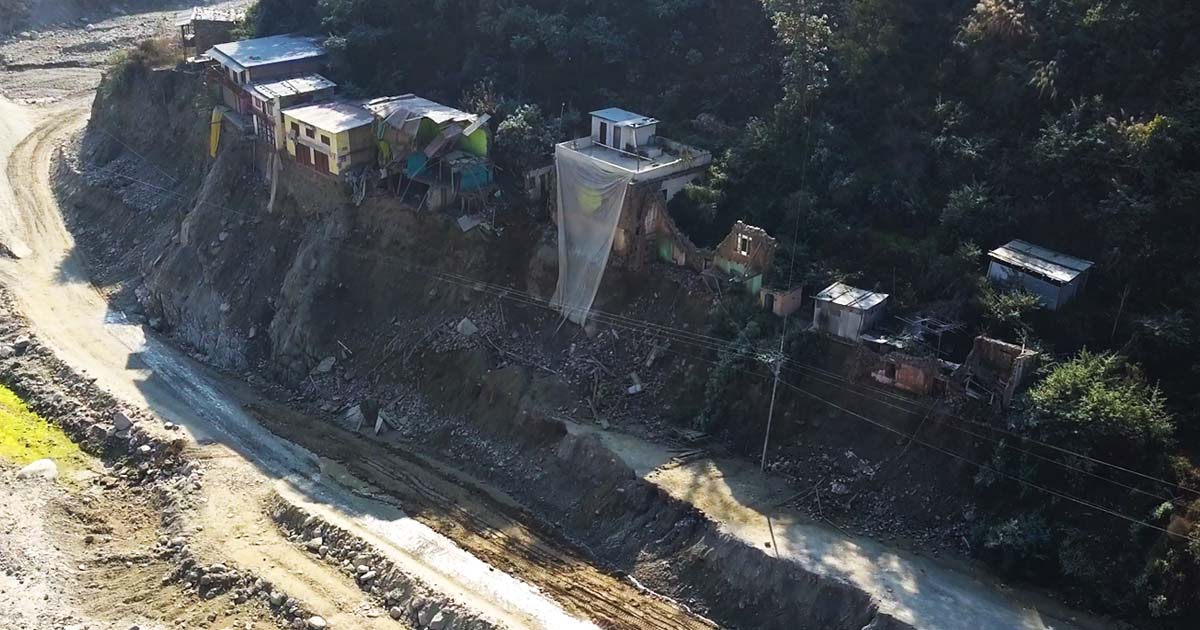
A collapsed house in Tilkechaur. Photo: Rakesh Nepali/NIMJN
Thakur Kandel compared the situation in Tilkechaur to an incident on May 2, 2025, where a moving vehicle collapsed into a sinkhole in Gairigaun, Hetauda, Makawanpur. He mentioned similar incidents have also occurred in Gongabu, Kathmandu, and Pokhara, Kaski.
According to Kandel, several measures could help minimize land cracks and subsidence in Tilkechaur. These include prohibiting large construction projects, avoiding the removal of large stones by excavation or blasting during roadwork, and launching a large-scale campaign to plant trees and grass, in addition to building concrete drains.
Geologists have identified four main reasons for the cracks in the underground rocks. The field study report by Thakur Prasad Kandel and Kabita Karki attributes the rock fissures to mechanical weathering processes, tectonic forces, changes in temperature and pressure, and chemical weathering. Geologist Thakur said these factors create cracks and slopes in the rocks, causing significant ruptures in the geological structure.
According to researchers, the freezing and melting of water seeping into rocks during winter and summer cause significant damage. When water seeps into small cracks and freezes, it expands, causing the cracks to widen and eventually break the rocks. Thakur Prasad Kandel noted that daily and seasonal temperature changes, especially in the Himalayan region, repeatedly put stress on the rocks.
Similarly, as plant roots grow into cracks, their expanding size can widen the fissures and split the rocks apart.
Geologist Dr. Soyta Shrestha explained that as the earth's surface erodes, the pressure on the underlying rocks decreases. This reduction in pressure causes the rocks to expand and crack.
In a seismic zone like Nepal, the movement of tectonic plates puts stress on the rocks. Earthquakes and movements along fault lines cause existing cracks to grow and new ones to form. Dr. Soyta Shrestha also said that shear stress has been found to move rocks apart, creating fractures and faults.
The causes and mechanics of land sinking
Geologists define a sinkhole as the sudden collapse or sinking of the land's surface. This occurs when the hard soil or rock on top is undermined by soft, water-soluble rock or soil underneath. As underground water erodes and carries away this softer material, the ground sinks, forming a sinkhole.
Senior geologist Professor Dr. Meghraj Dhital and Monika Jha, Director General of the Department of Mines and Geology, both state that land sinking is a sign of danger. Dr. Dhital believes that Pokhara is at the highest risk of sinking but other areas should also be monitored. His studies have identified many vulnerable locations in Pokhara. According to him, sinking can happen in hollow areas that contain limestone rocks, caves or other internal channels.
According to him, building ponds or roads without geological studies can cause sinkholes, especially if an earthquake strikes and changes the land's previous state, leading to sinking and collapse. Tampering with swamps formed by sinkholes can also damage nearby structures. He stated that people should not go to or build on sunken land without first conducting a geological study.
Monica Jha said the department is identifying areas at risk of sinking and raising awareness about these dangers. "We have urged people, even at the local level, to identify risky places and to take safety precautions when building physical structures or to avoid building in those places altogether," she said. According to her, some local bodies have not followed the department's recommendations.
Please adhere to our republishing policy if you'd like to republish this story. You can find the guidelines here.
Comments